
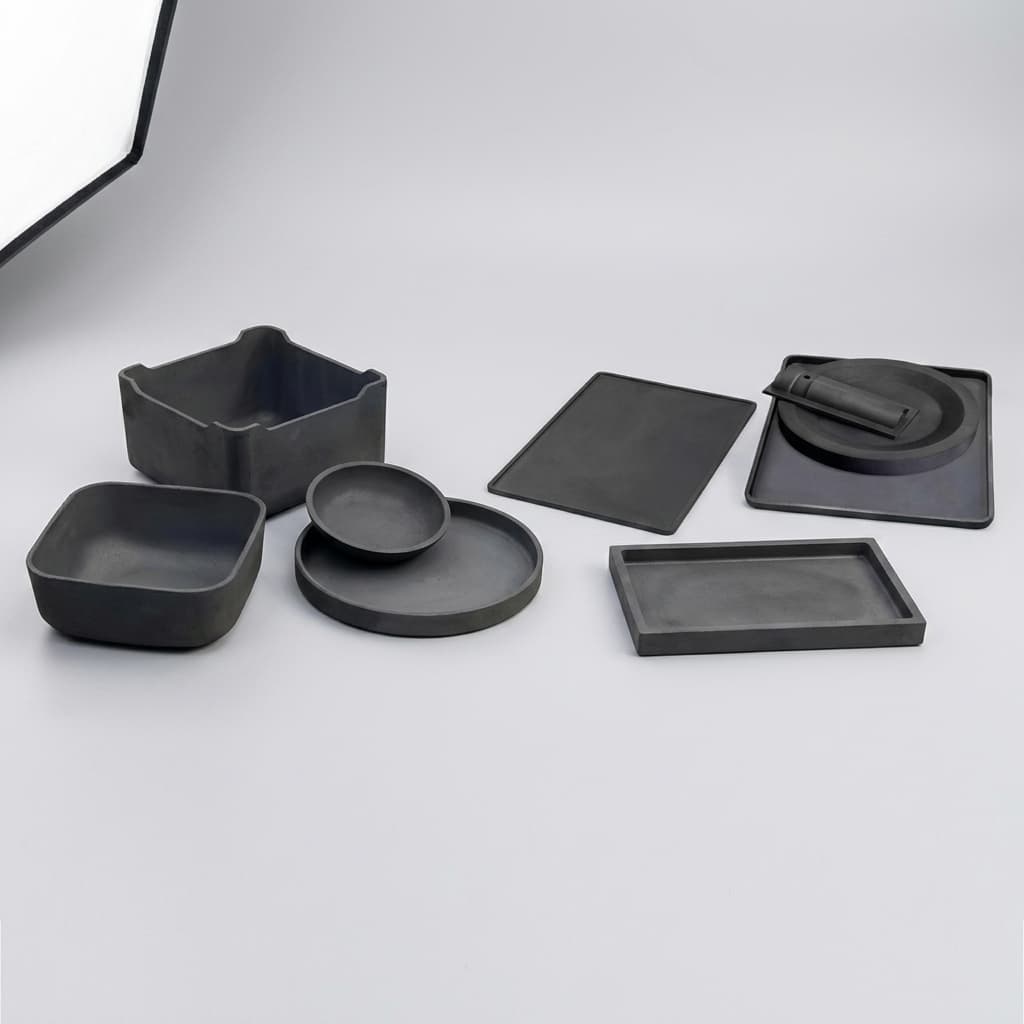
SiC Susceptor Lifespan: How H2 Etching Impacts Epitaxy Yield and TCO
Learn how H2 etching shortens SiC susceptor lifespan, raises epi defect risk, and changes TCO. Use Sicgraphite's checklist to qualify CVD SiC coatings.
As silicon carbide (SiC) power electronics scale toward 8-inch (200mm) production in 2026, the demands placed on epitaxial growth equipment have reached unprecedented levels. While much of the industry's focus has been on temperature uniformity and gas flow dynamics, a silent killer of yield and profitability often goes overlooked: Hydrogen () etching of the SiC-coated graphite susceptor.
For procurement teams, susceptor lifespan is a standard metric. However, for process engineers, the degradation of a susceptor dictates the defectivity rate of the epitaxial layer. Bridging the gap between these two perspectives is critical for optimizing the true Total Cost of Ownership (TCO).
Executive Summary
- The Core Issue: During high-temperature () SiC epitaxy, the carrier gas acts as a powerful etchant, attacking micropores in the susceptor's CVD SiC coating.
- The Yield Impact: Once the coating is breached, the underlying graphite releases carbon dust and trapped impurities, leading to catastrophic Basal Plane Dislocations (BPDs) and stacking faults on the wafer.
- The Procurement Shift: Purchasing decisions in 2026 are shifting from "cost per susceptor" to "effective yield cost," requiring strict audits of supplier CVD coating density and morphology.
Scope note, reviewed July 28, 2026: This guide is written for global procurement, process engineering, and equipment teams qualifying SiC-coated graphite susceptors for H2-rich SiC CVD epitaxy, typically around to . The run-count and premium ranges below are planning ranges, not guaranteed acceptance limits; actual lifespan depends on reactor geometry, wafer size, gas chemistry, pocket design, coating thickness, cleaning recipe, and incoming graphite purity.
1. The Chemistry of Susceptor Degradation: The Etching Mechanism
In SiC chemical vapor deposition (CVD) epitaxy, Hydrogen () is the standard carrier gas. At the extreme temperatures required for SiC epitaxial growth (typically to ), becomes highly reactive.
The protective CVD SiC coating on a graphite susceptor is designed to be inert. However, if the coating possesses microscopic pinholes, low-density regions, or an unfavorable grain structure, the gas will penetrate these weak points.
Once breached, the reacts with the underlying isostatic graphite substrate, forming hydrocarbon gases (like ). This subsurface etching creates localized voids beneath the SiC coating. Over multiple thermal cycles, these unsupported coating areas crack and flake off—a phenomenon known as micro-delamination.
Figure 1: Mechanism of hydrogen etching through porous coatings vs. protection offered by high-density columnar CVD SiC coatings.
2. From Particles to Killer Defects
When the substrate is compromised, two critical yield-killing events occur:
- Particulate Contamination: Microscopic graphite dust is swept into the process gas flow. If a particle lands on the growing epi-layer, it disrupts the crystal lattice, generating macroscopic morphological defects (e.g., triangular defects, carrots, or downfalls).
- Impurity Outgassing: Even "high purity" graphite contains trace metals (Fe, Ti, V). When the SiC seal is broken, these impurities outgas into the chamber, causing unintentional background doping and reducing carrier lifetime in the device.
These defects are catastrophic for power devices, particularly 1200V+ SiC MOSFETs, as they lead to high leakage currents and device failure.
3. Rethinking Procurement: The True TCO Model
A common procurement pitfall is evaluating susceptors based solely on the upfront unit price and the supplier's stated "average runs per susceptor." In high-value SiC epitaxy, the Effective Yield Cost model must be adopted.
The cost of a compromised susceptor is not just the replacement cost of the graphite part; it is the cost of the scrapped 200mm SiC wafers, the lost epi-reactor uptime, and the chamber cleaning required after a delamination event.
TCO Comparison Table: Standard vs. Premium Susceptors
| Metric / Attribute | Standard Susceptor (Low-Temp CVD) | Premium Susceptor (High-Temp CVD) | Impact on Epitaxial Process |
|---|---|---|---|
| Initial Unit Price | Baseline Cost ($) | Baseline + 20-30% | Higher upfront investment. |
| Coating Structure | Equiaxed / Micro-porous | Columnar / High-Density | Determines resistance to etching. |
| Expected Lifespan (Runs) | 50 - 80 runs | 120 - 150+ runs | Reduces physical replacement frequency. |
| Particle Generation Risk | High (after 40 runs) | Very Low (sustained) | Directly correlates to epi defect density. |
| Maintenance Downtime | Frequent chamber cleans | Scheduled, predictable | Maximizes MOCVD/Epi reactor uptime. |
| Effective Yield Cost (TCO) | High (Due to scrapped wafers) | Low (Consistent high yield) | The true metric for procurement ROI. |
If your SPC data already shows particle excursions after a repeatable run count, use the table as a screening worksheet and send your cleaning recipe, wafer size, run history, and pocket drawing through the contact page before placing the next replacement order.
4. Supplier Qualification Checklist for H2 Resistance
To ensure you are purchasing susceptors capable of resisting hydrogen etching and maximizing TCO, utilize this checklist during supplier audits and RFQ evaluations:
- 1. Request Coating Density Data: Do not accept generic "CVD SiC" descriptions. Request specific density measurements. The coating should be near the theoretical density of SiC ().
- 2. Audit the Microstructure: Request SEM (Scanning Electron Microscope) cross-sections of the coating. Look for a dense, columnar grain structure without interconnected porosity.
- 3. Verify High-Temperature Deposition: Confirm the supplier utilizes a high-temperature () CVD process, which is critical for forming a highly crystalline, chemically inert SiC layer.
- 4. Check CTE Matching: Ensure the supplier provides lot-specific CTE (Coefficient of Thermal Expansion) matching data between the specific graphite batch and the SiC coating to prevent micro-cracking during thermal cycling.
- 5. Review Acid Testing Results: Ask for accelerated life testing data, such as boiling HCl or HF/HNO3 acid immersion tests, which simulate aggressive chemical attack and verify coating integrity.
5. Frequently Asked Questions (FAQ)
Q: Can we extend the lifespan of a standard susceptor by modifying our epi process?
A: While lowering the growth temperature or reducing flow might marginally reduce etching, it fundamentally compromises the optimal growth window for SiC epitaxy, leading to poor crystal quality. The susceptor must be robust enough to handle the optimal process recipe, not the other way around.
Q: Does susceptor refurbishing (re-coating) solve the H2 etching problem?
A: Susceptor refurbishment is viable, but only if the original graphite substrate was not deeply etched. If has already compromised the substrate geometry or introduced deep impurities, stripping and re-coating will not restore its performance.
Q: How do we detect H2 etching before it causes wafer defects?
A: Implement strict statistical process control (SPC) on your in-line defect inspection tools. A sudden uptick in particulate-induced defects (like downfalls or carrots) is often the first leading indicator that the susceptor coating has been breached.
6. Sources and References
- TrendForce 2025/2026 SiC Market Insights: Analysis on the global SiC supply chain and the critical importance of yield optimization in the transition to 8-inch wafers. View market report
- Process-Structure-Property Correlation in CVD-SiC Coatings of Graphite Susceptors: Open-access research on how CVD-SiC coating process and microstructure affect coating quality for graphite susceptors in semiconductor use. Review open-access study
- Mersen Technical Bulletin on CVD SiC Coatings: Detailed breakdown of how CVD coating morphology (columnar vs. equiaxed) dictates chemical resistance in semiconductor applications. Download technical brochure
Optimize Your SiC Epitaxy Yield
Don't let inferior susceptor coatings bottleneck your 200mm SiC production. Our premium CVD SiC Coated Susceptors feature ultra-high density, columnar grain structures specifically engineered to withstand aggressive etching at . Contact our engineering team to discuss how our CTE-matched solutions can dramatically lower your Effective Yield Cost.
Author

More Posts
Graphite Heating Elements in High-Temperature Vacuum Furnaces: Meander vs. Cage Geometry, Arcing Prevention, and Creep Resistance
Compare graphite heating elements for vacuum furnaces: meander vs. cage, arcing risks, creep, and terminal design. Build your RFQ with an acceptance checklist.
CVD SiC Coating vs. Bare Graphite in MOCVD: A Cost & Contamination Analysis
Why bare graphite fails in modern MOCVD. Analyze trace metal contamination, wafer slip, and the lifetime ROI of CVD SiC coated susceptors.
C/C Composite Fasteners vs. Molybdenum in Vacuum High-Temperature Furnaces
A technical comparison of Carbon/Carbon composites and Molybdenum hardware in vacuum furnaces. Discover why C/C composites are replacing refractory metals.